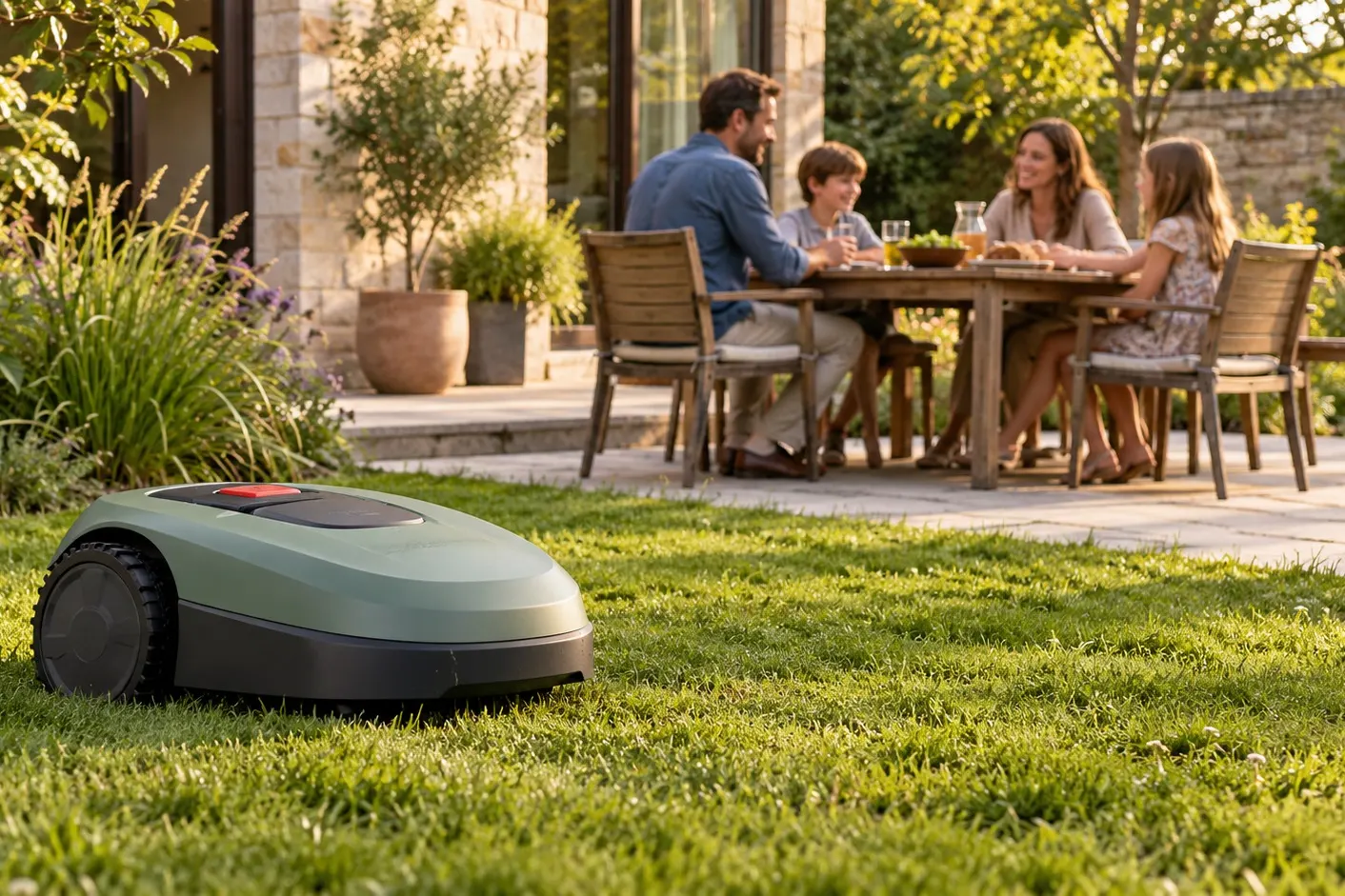
A front lawn and a back lawn are no problem for most wire-free mowers. Every model we track can split its map into separate areas, and the apps let you draw a path between them that the mower follows by itself. Whether it works in your yard depends mostly on the route between the lawns, its width and what's on it.
Maps, zones and paths
Makers use the words a little differently, but the idea is the same. The mower has one map of everything it can reach from its base. Within that map you draw zones, which can each get their own schedule or cutting height, and paths or channels that connect them. Mammotion's product page for the LUBA 3 gives up to 50 mowing zones in one place and 100 "smart zones" in another, with paths between areas. Roborock lets you create several passages between lawns.
Some brands do set limits. Worx recommends at most three mowing areas in the same time slot for the Landroid Vision. Eufy recommends its multi-zone pathway for lawns up to 60 m (197 ft) apart, and each Eufy base station holds one map.
What each brand supports
| Brand | Models | Zones per map | Longest path published |
|---|---|---|---|
| Segway Navimow | 15 | 12 to 120 | – |
| Mammotion | 13 | 10 to 50 | – |
| Husqvarna | 8 | 20 | – |
| Roborock | 7 | 28 | – |
| Dreame | 6 | 150 (not published for every model) | – |
| Ecovacs | 6 | – | – |
| Mova | 5 | 150 | – |
| Hookii | 4 | 30 to no limit | – |
| Worx | 4 | – | 6 m (20 ft) |
| Airseekers | 3 | 80 | – |
| Anthbot | 3 | 20 to 30 | – |
| Eufy | 3 | – | 60 m (197 ft) |
| Sunseeker | 3 | no limit | – |
| GOKO | 2 | 250 | – |
| Lymow | 2 | 80 | – |
| Greenworks | 1 | – | – |
| RoboUP | 1 | 3 | – |
| Yarbo | 1 | 150 | – |
Wire-free models on sale in at least one of the US, Canada, the UK and Australia. Each model page lists its own figure.
The route between your lawns
A path between lawns has to meet the same width rules as any other passage. Most makers ask for 70 cm to 1 m, Husqvarna more, and the gate post or the corner of the house is usually the narrowest point. Our guide to narrow passages lists the minimum per model. Husqvarna's advice for its EPOS paths is simply to make them as wide as possible.
Paving and gravel are usually fine on a mapped path, and Worx says even its camera-based Landroid Vision crosses driveways and walkways. Curbs and steps are harder. Where makers publish how high an obstacle their mower can drive over, the middle value is 50 mm (about 2 in), and each model page lists its own figure.
Crossing a driveway takes some planning. Mammotion's manual says not to set work areas or paths across public pathways, and Eufy suggests avoiding crossings at times when cars regularly enter or leave. Set the schedule so the mower crosses during the day when no cars are using the driveway, or split the lawns into two maps.
More lawns means more margin
Every trip between lawns costs time, and each separate area adds edges and turns. The fit check accounts for that. With more than one lawn it calls a model a clear fit only if your total lawn uses 70% or less of the rating, instead of 80%. It also checks the number of lawns against each model's published zone limit, and the length of your path where the maker gives a maximum.
If the mower can't drive between the lawns, choose "It can't, I'd carry it" in the check. Models then show as a tight fit, because you'll be lifting the mower across by hand every time that lawn is due.
When two mowers make more sense
Two smaller mowers each get their own base, which avoids the driveway, the narrow gate and the carrying. It is worth pricing them against one bigger model when the lawns are far apart, when a public sidewalk or a road sits between them, or when one of them is under trees and the other is open. In that last case a LiDAR model for the shady lawn and a satellite model for the open one often make a better pair than one mower for both. Our guide to mowers under trees explains why.
Common questions
Can a robot mower cut a front and back lawn?
Yes. Every one of the 87 wire-free models we track can store more than one area and drive between them on a path you map. The catch is the route. It needs a passage wide enough for the mower and, if it crosses a driveway or sidewalk, a schedule that keeps it off when cars are moving.
Can a robot mower cross a driveway or sidewalk?
Most satellite and LiDAR models can follow a mapped path across a driveway. Mammotion tells owners not to set work areas or transport paths across public pathways, and Eufy suggests not scheduling crossings when cars regularly come and go. If a public sidewalk separates the lawns, carrying the mower or buying two is the safer choice.
What is the difference between a zone and a map?
A map covers everything one base station serves. Zones are areas within that map that you can schedule or set up differently, such as a different cutting height for the back lawn. Some brands also store several maps, for example for a second property, and you may need to move or add a base station for each one.
More guides
-
 Robot mowers for slopes and hills: what the ratings meanWhat a slope rating covers, why the edge of a slope is harder than the middle, and which mowers are rated for steep lawns.
-
 Robot mower for 1 acre: how big a rating you needWhy a mower rated for exactly 1 acre struggles on 1 acre, and how much headroom to look for.
-
 Robot mowers under trees: RTK, camera or LiDARHow each way of finding its position copes with tree cover, roofs and tall walls.
-
 Robot mowers for narrow gaps and side passagesMakers ask for anything from 55 cm to 2 m. The minimum gap per model, and how to measure yours.
-
 Do robot mowers get stolen? Anti-theft features comparedPIN codes, alarms, account locks and GPS tracking, and which of them need a data plan.
-
 How much does a robot mower cost?Shop prices per country from our latest price check, plus blades, data plans and batteries.