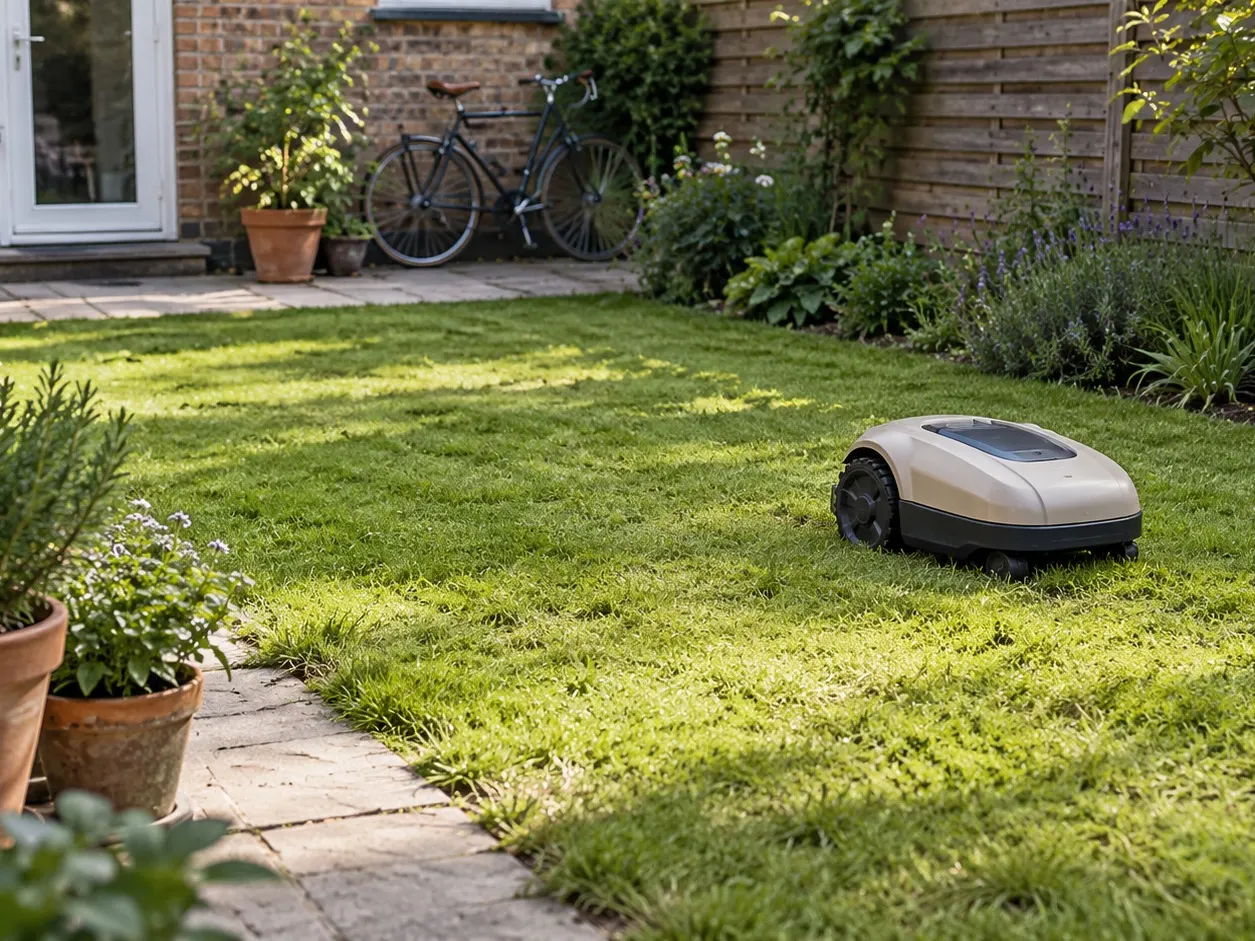
Plenty of wire-free mowers can't get through a typical side passage between a house and a fence. The mowers themselves are 38 to 61 cm wide, but most makers ask for a gap of 70 cm to 1 m before they'll promise it gets through, and a few ask for 2 m. The smallest published minimum among the 87 models on sale in our four countries is 55 cm (22 in), and for 17 of them there is no published figure at all.
Why the gap has to be much wider than the mower
For the models where we know both the minimum gap and the body width, the gap is typically 45 cm wider than the mower itself. That margin is for positioning. A satellite mower's fix can wander by a few centimeters, and close to a wall or under the eaves it gets worse, because the house blocks part of the sky. And a mower rarely arrives square to the gap, so it needs a few centimeters on each side to straighten up. That's how a mower can be narrower than your gap and still refuse to go through.
In the fit check, a satellite mower in a narrow passage next to tall walls shows as a tight fit for that reason, even when the published minimum is met.
What the makers ask for
Navimow gives a minimum of 100 cm (39.3 in) in its support articles for the X3, H2, i1 and i2 LiDAR. Ecovacs needs at least 0.8 m for its O LiDAR PRO models to map a passage by themselves, and 0.9 m for the A LiDAR PRO models. Mammotion says the LUBA 3 fits through gaps as narrow as 70 cm (27.6 in). Husqvarna's manual for the Automower 410, 420 and 440 iQ asks for at least 2 m (6.6 ft) for a passage between objects. Eufy's general advice is that "around 80–100 cm can be a useful starting point".
Of the models with a published figure, 36 manage with 80 cm or less, 24 need 1 m and 8 need 2 m.
Models that fit through 80 cm (31 in) or less
| Model | Minimum gap | Body width | Positioning | Sold in |
|---|---|---|---|---|
| Mammotion YUKA mini 2 1000 | 55 cm (22 in) | – | LiDAR | Australia |
| Mammotion YUKA mini 2 1000H | 55 cm (22 in) | – | LiDAR | US, Canada |
| Dreame A3 AWD 1000 | 60 cm (24 in) | 43 cm (17 in) | LiDAR | US, Canada |
| Dreame A3 AWD 2000 | 60 cm (24 in) | 43 cm (17 in) | LiDAR | US, Canada |
| Mova LiDAX Pro 800 | 60 cm (24 in) | 45 cm (18 in) | LiDAR | US |
| Mova LiDAX Ultra 1000 | 60 cm (24 in) | 45 cm (18 in) | LiDAR | US, Canada |
| Mova LiDAX Ultra 2000 | 60 cm (24 in) | 45 cm (18 in) | LiDAR | US, Canada |
| Mammotion LUBA mini 2 AWD 1500 | 68 cm (27 in) | 46 cm (18 in) | LiDAR | UK, Australia |
| Mammotion LUBA mini 2 AWD 1500H | 68 cm (27 in) | 46 cm (18 in) | LiDAR | US |
| Ecovacs GOAT O1000 RTK | 70 cm (28 in) | 40 cm (16 in) | RTK satellite | US |
| Ecovacs GOAT O800 RTK | 70 cm (28 in) | 40 cm (16 in) | RTK satellite | UK |
| Mammotion LUBA 3 AWD 1500 | 70 cm (28 in) | – | LiDAR | Canada, Australia |
| Mammotion LUBA 3 AWD 1500H | 70 cm (28 in) | – | LiDAR | Canada |
| Mammotion LUBA 3 AWD 3000 | 70 cm (28 in) | – | RTK + LiDAR + camera | US, Canada, Australia |
| Mammotion LUBA 3 AWD 3000H | 70 cm (28 in) | – | RTK + LiDAR + camera | Canada |
| Mammotion LUBA 3 AWD 5000 | 70 cm (28 in) | – | RTK + LiDAR + camera | Canada, Australia |
| Roborock RockNeo Q1 | 70 cm (28 in) | – | RTK + camera | Australia |
| Roborock RockNeo Q110H | 70 cm (28 in) | – | RTK + camera | US |
| Hookii Neomow X (2025) | 77 cm (30 in) | 51 cm (20 in) | LiDAR | US |
| Roborock RockMow X115H | 79 cm (31 in) | 48 cm (19 in) | RTK + camera | US |
| Roborock RockMow X130H | 79 cm (31 in) | 48 cm (19 in) | RTK + camera | US |
| Anthbot Genie 1000 | 80 cm (31 in) | – | RTK satellite | US, Australia |
| Anthbot Genie 3000 | 80 cm (31 in) | – | RTK satellite | US |
| Anthbot Genie 600 | 80 cm (31 in) | – | RTK satellite | US |
| Dreame A3 AWD Pro 2500 | 80 cm (31 in) | 53 cm (21 in) | LiDAR | Canada |
| Dreame A3 AWD Pro 3500 | 80 cm (31 in) | 53 cm (21 in) | LiDAR | US, Canada |
| Dreame A3 AWD Pro 5000 | 80 cm (31 in) | 53 cm (21 in) | LiDAR | US, Canada |
| Ecovacs GOAT O1000 LiDAR PRO | 80 cm (31 in) | 48 cm (19 in) | LiDAR | US |
| Ecovacs GOAT O1200 LiDAR PRO | 80 cm (31 in) | 48 cm (19 in) | LiDAR | UK |
| Roborock RockMow X120H LiDAR | 80 cm (31 in) | – | LiDAR | US |
| Roborock RockMow Z1 (Z150) | 80 cm (31 in) | – | RTK + camera | UK, Australia |
| Roborock RockMow Z1 LiDAR | 80 cm (31 in) | – | LiDAR | UK |
| RoboUP Raccoon 2 SE | 80 cm (31 in) | – | Camera only | US |
| Sunseeker X5 Gen 2 | 80 cm (31 in) | – | RTK + camera | US |
| Sunseeker X7 Gen 2 | 80 cm (31 in) | – | RTK + camera | US, UK |
| Sunseeker X7 Plus Gen 2 | 80 cm (31 in) | – | RTK + camera | UK |
Figures from manufacturer specs as of Oct 26, 2026. A dash means the maker doesn't publish it.
How to measure your gap
Put the tape measure between whatever doesn't move. Often that's a gate post or a downspout, sometimes the corner of a raised bed or the trash can that always stands in the same spot. Check at ground level and again about 30 cm (a foot) up, because a shrub leaning into the path catches the mower's body long before it touches the wheels. The smaller number is the one that counts.
Plants grow into a passage over the summer, so measure it in July rather than March. A hedge you trimmed hard in spring can take back a surprising amount of the path by August.
When the gap is too narrow
Widening the gap is often easier than it sounds: moving the trash cans or trimming a hedge can gain the 10 to 20 cm that make the difference. You can also map the lawns separately and carry the mower over now and then, which most apps support. Or pick a mower with a smaller published minimum from the table above, and check its other figures against your lawn.
In the fit check, choose your gap width under "More details". If you're not sure, choose "Not sure". The check then leaves the gap out of the result, shows each model's minimum on its card, and moves models that need a wide or unknown gap down the list.
Common questions
What is the narrowest gap a robot mower can get through?
The smallest published minimum among wire-free models on sale in the US, Canada, the UK and Australia is 55 cm (22 in), for the Mammotion YUKA mini 2 1000. Most makers ask for 70 to 100 cm, and Husqvarna asks for 2 m on its iQ models.
Can I make a passage wide enough with a removable panel or gate?
Yes, as long as it is open whenever the mower is scheduled to pass. An open gate works the same as any other gap, and the narrowest point is what counts, often the gate post or a hinge. If the gate is closed on some days, map the lawns separately and expect to carry the mower or skip that area.
More guides
-
 Robot mowers for slopes and hills: what the ratings meanWhat a slope rating covers, why the edge of a slope is harder than the middle, and which mowers are rated for steep lawns.
-
 Robot mower for 1 acre: how big a rating you needWhy a mower rated for exactly 1 acre struggles on 1 acre, and how much headroom to look for.
-
 Robot mowers under trees: RTK, camera or LiDARHow each way of finding its position copes with tree cover, roofs and tall walls.
-
 Robot mowers for two or more separate lawnsFront and back lawns, paths, driveways and how many separate areas each brand supports.
-
 Do robot mowers get stolen? Anti-theft features comparedPIN codes, alarms, account locks and GPS tracking, and which of them need a data plan.
-
 How much does a robot mower cost?Shop prices per country from our latest price check, plus blades, data plans and batteries.